Showing posts with label YA Nonfiction. Show all posts

Saturday, August 10, 2019

Books about body parts, croaking and choking!


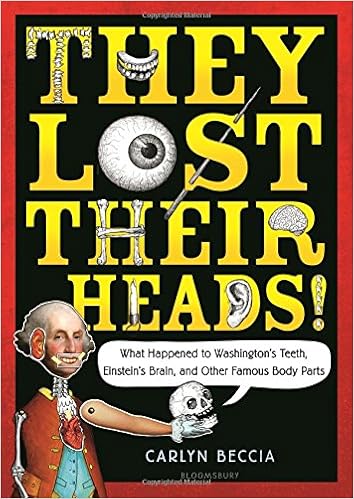
I love this book, it is delightfully creepy and gruesome!
I read this book as part of the Young Hoosier Book Award Program, it is nominated for the 2019-2020 school year.

Scholastic has a great book trailer in which Carlyn Breccia describes her book, readers will enjoy this tease of creepy information.

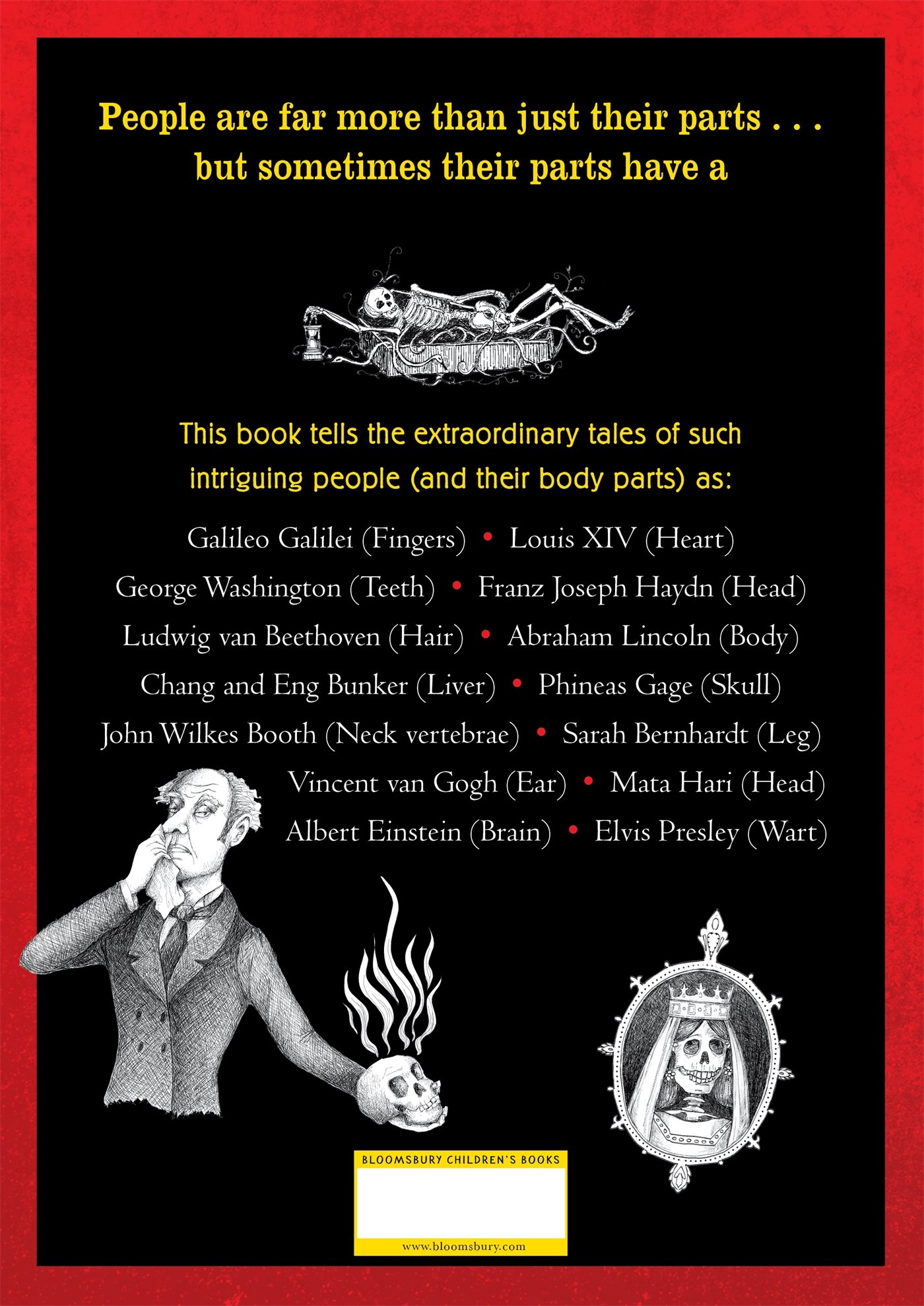
The author Carlyn Beccia does a great job of balancing macabre and the middle grade reader. Readers will enjoy the creepy subject matter and the mysteries surrounding famous body parts including:

The famous people and their body parts include:
Galileo Galilei / Fingers
Louis XIV / Heart
George Washington / Teeth
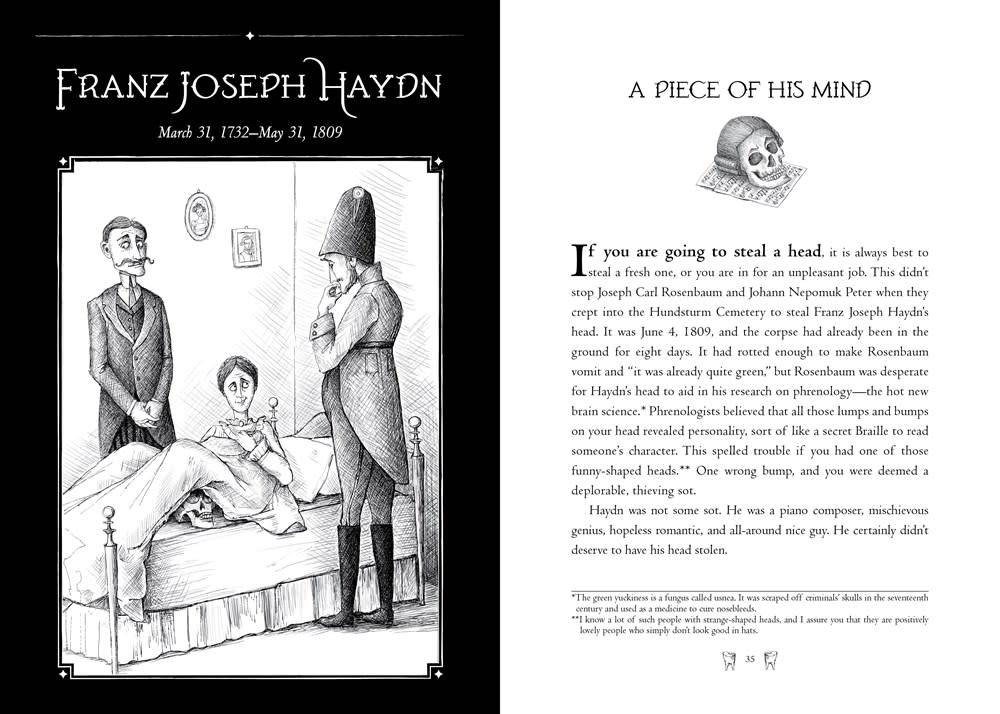
Franz Joseph Hadyn / Head
Beethoven / Hair
Abraham Lincoln / Body
Chang and Eng Bunker / Liver
Phineas Gage / Skull
John Wilkes Booth / Neck vertebrae
Sarah Bernhardt / Leg
Vincent Van Gogh / Ear
Mata Hari / Head
Albert Einstein / Brain
Elvis Presley / Wart
Thomas Edison / Last Breath

Image result for they lost their heads

The book contains many illustrations that add humor and depth to the stories.

Image result for they lost their heads


If this book entertains you I would also recommend these books by Georgia Bragg. Readers will be fascinated by these tales of famous people croaking, choking and being caught!


How They Croaked18594549

Coming in September 2019......

 43999129     Monstrous: The Lore, Gore, and Science behind Your Favorite Monsters by [Beccia, Carlyn]

Sunday, April 2, 2017

Readers Advisory Matrix - Primates: The Fearless Science of Jane Goodall, Dian Fossey, and Birute Galdikas


Readers Advisory Matrix - Primates: The Fearless Science of Jane Goodall, Dian Fossey, and Birute Galdikas


  1. Where is the book on the narrative continuum? This is a graphic novel and reads like narrative nonfiction.
  2. What is the subject of the book? The book looks at the study of primates and three female scientists that made major breakthroughs in this area.
  3. What type of book is it? Graphic narrative nonfiction novel
  4. Articulate Appeal
    1. What is the pacing of the book? The pacing is quick, this might be in part due to it being a graphic novel.
    2. Describe the characters of the book. The story focuses on Dian Fossey, Jane Goodall and Birute Galdikas and how they ended up in the field studying primates. All three of the women had many things in common. They were all very intelligent and dedicated to their work.
    3. How does the story feel? Though these ladies experienced many trials and tribulations during their time the story focuses on the good.
    4. What is the intent of  the author? To educate about the breakthroughs these women made in their field.
    5. What is the focus of the story? Louis Leakey found these women and helped secure funding for their research, he was positive that women would make greater strides with primates than men, Goodall studies chimps, Fossey studied gorillas and Galdikas studies orangutans.
    6. Does the language matter? Yes, it is written in language everyone can understand. As an introductory book on the topic, it is important that a layperson be able to understand the words used.
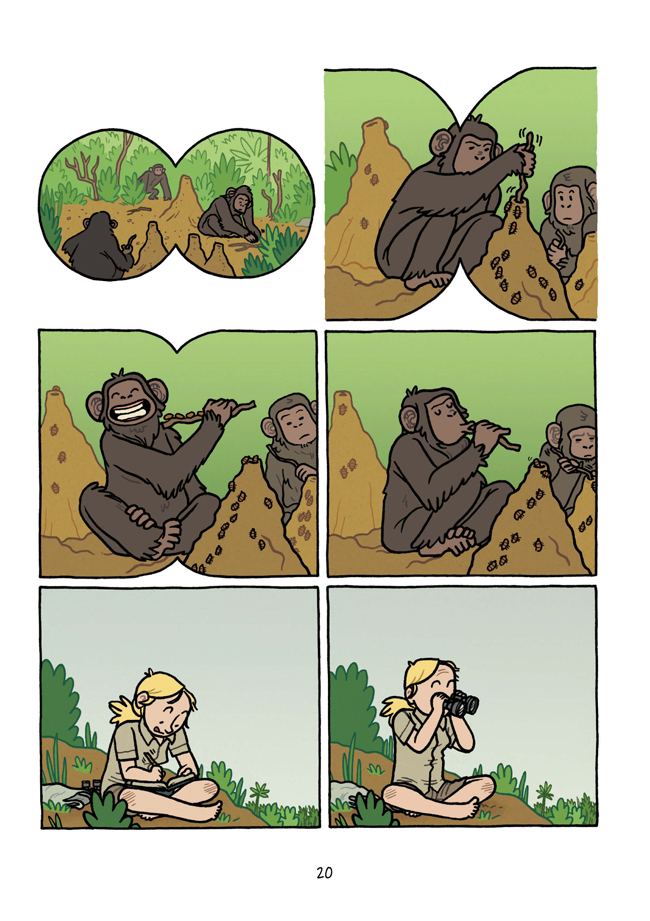
    7. Image result for primates bookIs the setting important and well described? The setting is very important, the scientists studied the primates in their habitat. Good descriptions are given and graphics also add to the details about the habitat.
    8. Are there details and, if so, of what? There are details about how each scientist worked hard to get close to the different kind of primates, their habitats and their discoveries.
    9. Are there sufficient charts and other graphic materials? Are they useful and clear? It is a graphic novel so there are plenty of pictures, there aren’t any charts to support the story.
    10. Does the book stress moments of learning, understanding and experience? The book focuses on these three things and on the breakthroughs the women made in the study of primates.
  5. Why would a reader enjoy this book.
    1. Rate appeal.
      1. Great graphics
      2. Good story
      3. Educational

Monday, March 6, 2017

Special Topics Paper - Reader's Advisory For Teens

Social Media is a great tool to use in Reader's Advisory for Teens. Here are some ideas on how social media platforms can be used to provide book recommendations for teens.

Reader's Advisory for Teens

Booktalks are a great way to to promote reading to teens. Many social media platforms now allow videos to be posted including: Snapchat, Facebook and Instagram. When creating a booktalk to post on social media, the librarian needs to keep in mind the time constraints of each platform, for example Snapchat videos are limited to ten seconds. Snapchat also allows the user to add filters that pertain to the setting or content of the book. Videos could be created for new items in the Teen Section, Read-alikes, and other items the library is currently promoting.
Image result for booksnapsA book snap is a picture of text from a book that is focusing on a quote or idea in the text with emojis, text or other content added to illustrate the point. The book snaps are typically shared on Snapchat and Twitter.  The librarian can share quotes or highlights from the book they are reading or promoting and post it to the social media app. Book snaps could also be used to share what the librarian is currently reading by posting a picture of the book cover with a few words about the book or with the words, currently reading. Book snaps of a book cover could be shared on all social media platforms. Sharing what one is currently reading or has read recently is a great way to get teenagers talking about books.
There are multiple websites available that will allow a patron to get a reading recommendation, Goodreads and Library Thing are among some of the popular websites. The teen librarian could create a profile on these sites to promote what they are currently reading and assist teen patrons in doing so as well. Posting links to these accounts on the library website and social media platforms will allow the library to reach more users. Goodreads allows a user to add friends and follow what they are reading and make recommendations to others as well.

Image result for book infographicInfographics are graphic visual representations of information and have become very popular. There are many free programs that allow you to create these, such as: Piktochart, Canva and Venngage. This is a great way to recommend books through the use of Read-alikes or specific topics.  For example an infographic could be made about what to read if you like the tv series The Walking Dead. These posters could then be displayed at the library in the teen section or shared on the library’s social media platforms.

Works Cited

Brown, David W. "How Young Adult Fiction Came of Age." The Atlantic. N.p., 01 Aug. 2011. Web. 2 Mar. 2017.
Burgess, Dave. "#BookSnaps!!" Blog post. Teach Like a Pirate. N.p., n.d. Web. 6 Mar. 2017.
Graves, Alanna. "How To Use Snapchat for Readers' Advisory." School Library Journal(2016): n. pag. Web.
Thorton-Verma, Henrietta, and Meredith Schwartz. "The State of Readers' Advisory."Library Journal 03 Feb. 2014: n. pag. Web. 2 Mar. 2017.

Tuesday, November 8, 2016

Crime and Forensic Science Young Adult Pairings

Crime and Forensic Science Young Adult Pairings

I am focusing on pairing crime fiction and forensic/true crime
nonfiction for young adults. My inspiration for this topic is the recent
Holiday, many students love scary movies and I recently read My
Friend Dahmer, I really enjoyed it and I know it has a high circulation
at our school library. I would design a display with most wanted signs,
crime tape, magnifying glasses, and evidence bags. I would set the
display up close to the Young Adult section and on a major path in the
library. I would advertise on the library website, Twitter and Facebook
pages. A potential problem could be that some parents may not like
the graphic nature of the material. The benefits of these pairings is
that it can introduce a variety of type of nonfiction books to young
adults.

My first pairing is about Jack the Ripper, a famous serial
killer from London in the 1800s. A study or display is not
complete without Jack the Ripper.

Jack the Ripper: A Journal of the Whitechapel
Murders 1888-1889
Rick Geary

This is a black and white graphic nonfiction work about the
serial killer Jack the Ripper. This case is very fascinating because the killer
was not found and the murders were never solved. I chose this option
because it is done in black and white so it is not as controversial as some of
the other graphic novels about Jack the Ripper.


Stalking Jack the Ripper
Kerri Maniscalo

This gothic thriller is set in the 1800s focuses on a lord’s
daughter who secretly studies forensic science in her
uncle’s laboratory. Her work brings her close to the
investigation of a serial killer which may put her in grave
danger.


My second pairing takes a look at what it looks like when someone is trying
not to be a serial killer. I thought this pairing would be unique because in My
Friend Dahmer, Jeff doesn’t know how to escape his unusual desires and in
I Am Not a Serial Killer, John has a very strict set of rules to ensure he does
not become a serial killer.

My Friend Dahmer
Derk Backderf

This graphic novel is a true accounting of what Jeffrey
Dahmer’s high school experience was like. It is written by
one of his high school classmates and probably one of his
only friends. This memoir gives real insight into some of
the things that probably led him on his path.


I Am Not A Serial Killer
Dan Wells

John is obsessed with serial killers and knows he is
dangerous. Is he really capable of being a serial killer, he
thinks he can prevent it by following a set of rules that will
make him appear as normal as possible. Will he be able to
keep this up when presented with danger?


My third pairing is based on a novel that kind of resembles the Natalee
Holloway case. The first is a novel and the second is an informational text
about forensic science.


Dangerous Girls
Abigail Haas

On a spring break trip to Aruba Anna’s best friend is brutally
murdered. Anna is trapped in the country and everyone is
convinced she is guilty. Will the judge agree or will she be
proven innocent.


Hidden Evidence: 40 True Crimes and How Forensic
Science Helped Solve Them
David L. Owen

This informational text explains the scientific procedures that
helped solve 40 cases. This includes: fingerprinting,
autopsies, handwriting analysis, ballistics, hair sampling,
blood typing, DNA testing, dental records, gas
chromatography, mass spectrometry, compound and electron microscopes,
and toxicology.

My fourth pairing is all about bones, can you solve a crime just based on a
skeleton, can you solve a crime without a body?


The Lovely Bones
Alice Sebold

A family is devastated by their teenage daughter’s
disappearance. Susie describes the murder from heaven,
while the family suffers not knowing what happened. Susie
keeps vigil over her family while hoping her murderer is
found and punished.


Forensic Identification: Putting a Name and Face on
Death
Elizabeth A. Murray

This book looks at how forensic scientists identify victims
and criminals by studying autopsies, facial
reconstructions, fingerprints, and DNA evidence.


My fifth pairing is a novel about cold cases in the FBI being solved with the
help of gifted teenagers and a nonfiction forensic title looking at how forensic science plays a role in the criminal justice system. This would be a great
pairing for those that love TV shows like Criminal Minds and CSI.


The Naturals
Jennifer Lynn Barnes

Cassie has been asked by the FBI to help use her gift
at profiling people to help solve cold cases. As Cassie
works with other gifted teenagers to solve these cases
they are caught up in a deadly game of cat and mouse.


Blood, Bullets, and Bones: The Story of Forensic
Science from Sherlock Holmes to DNA
Bridget Heos

The author uses real life cases to tell the history of
modern forensic science. In doing this she shows the
the essential part forensics plays in the criminal
justice system.
Friday, October 28, 2016

Bad Girls of Fashion

Bad Girls of Fashion: Style Rebels from Cleopatra to Lady Gaga

By: Jennifer Croll


The book  cover the lives of ten women who made history and hugely impacted fashion. If it had not been for their influence fashion would not be what we know it today. Included are Cleopatra, Marie Antoinette, Coco Chanel, Marlene Dietrich, Madonna, and Lady Gaga. Sidebar subjects include: Elizabeth I, Marilyn Monroe, Rihanna, and Vivienne Westwood.

Photos and illustrations show the fashion risks and trends that these ladies took or started in their lives. This book will educate you about how fashion has changed through history but also how it has been used socially and politically as a tool to cause change. 

The book includes lots of trivia interspersed throughout.  For example Cleopatra knew nine languages and wrote medical texts and Marie Antoinette did not say "Let them eat cake".

I did find the way the book was organized confusing, but overall enjoyed learning about these powerful women and the history of fashion.

I think this would be a great read for those interested in fashion, art, history, or feminism. 


Publisher: Annick Press
Date: October 11, 2016
Age Range: 12 Years
Grade: 7+


Readalikes:


Tuesday, October 11, 2016

Stronger Than Steel


Stronger Than Steel: Spider Silk DNA and the Quest for Better Bulletproof Vests, Sutures, and Parachute Rope

By: Bridget Heos
Photographs: Andy Comins


First of all I hate spiders with a passion so for me to read a book that has anything to do with spiders is pretty unusual. Despite this fact, I found the book to be quite enjoyable.

The book takes us both in the field and lab to learn about the world of genetics through the study of spider silk. The book has a narrative approach and contains difficult science topics that are explained 
in a way young readers can understand. A wide variety of pictures are included that adds to the understanding of what is being explained. 

Randy Lewis takes spider DNA and injects it into goats, bacteria, silkworms and alfalfa in an attempt to discover a better way to produce spider silk. The books takes you through each of these process in detail. 

The strongest spider silk is five times stronger than steel, the possibilities for this are amazing! Spider silk could be used to produce a lighter but safer bulletproof vest and could be used to produce replacement tendons and ligaments in the medical field to just name a few of these amazing possibilities.


Publisher: HMH Books for Young Readers
Date: February 26, 2013
Lexile Level: 860L
Grade Level: 5-7

Educator Information:

I would recommend this book as a read aloud to introduce a unit on DNA or genetics, a topic for a book report or a book for a student that is very interested in spiders, DNA, or genetics. This book also addresses GMOs and could be used to start a discussion, a debate or introduce the topic to a class.

This book is part of the Scientists in the Field Series. This series introduces young readers what goes on in the field and the lab during various scientific studies in a way that is both entertaining and educational. The series covers a wide variety of scientific topics and would be a great resource in any science classroom.

http://www.sciencemeetsadventure.com/

The website provides an educators guide that is available for download.

Here are a few of the other books in the series I would recommend if you like this book.


Monday, September 26, 2016

A nonfiction project in my classroom!


A nonfiction project in my classroom!

With my library science classes I have been reintroduced to the world of nonfiction! It is much different now than I remember it being when I was in High School, or it may have been I wasn't reading the right books.

There are so many nonfiction books on different science topics that I teach in my classes. I think my students could benefit greatly from adding these to my curriculum. Nonfiction books can add a depth to the topic that textbooks just can't. I am also able to support many different reading levels and interests with this project within one topic area as well. The book selection for space is amazing and my students are fascinated by it.

So I am working on writing a grant, I have created a donors choose project, and an Amazon Classroom Book Wish List to try and get some books into the hands of my students. I appreciate any support you can give.

Donors Choose
Classroom Book Wish List

Check out some of the books I am interested in!


My Friend Dahmer, A look at a nonfiction graphic memoir by Derf Backderf

My Friend Dahmer
by Derf Backderf

A student of mine recommended this book to me and this book is very popular at the school library. I love reading crime and mystery fiction but this was my first nonfiction book in that genre.

This is a graphic novel and I think this was the best format for this memoir.  The author was a classmate of the serial killer Jeffrey Dahmer and provides a unique perspective of what led up to Dahmer's killing spree.


I think case studies should be made about incidents like these to show teachers and school administrators that this really does happen. This is a sad story because he didn't get the help he needed as a student. I think students find this story interesting because they get insight on what caused him to end up where he did. It could be an interesting read and discussion for a Psychology class.

I found the book interesting but I think I would have enjoyed the book more if it had been focused on the crime, catching Jeffrey Dahmer, the evidence and the trial.


I would recommend the following books if you are interested in true stories about famous crimes.

GoodReads  Goodreads
Goodreads  GoodReads


NATIONAL BESTSELLER
2013 ALA/YALSA Alex Award
2014 Revelation Award at Angoulême
2015 ALA/YALSA Alex Award (Excellence in Narrative Nonfiction)

Publisher: Harry N. Abrams
Date: March 1, 2012
Grade Level: 7-12

Teacher Guide: https://www.abramsbooks.com/pdfs/academic/MyFriendDahmer_TeachingGuide.pdf

Novels in Verse in 5th Grade - Starfish & A Work in Progress

 It's been awhile since I have posted anything. However, being back in the classroom has inspired me to post about the books I am using ...